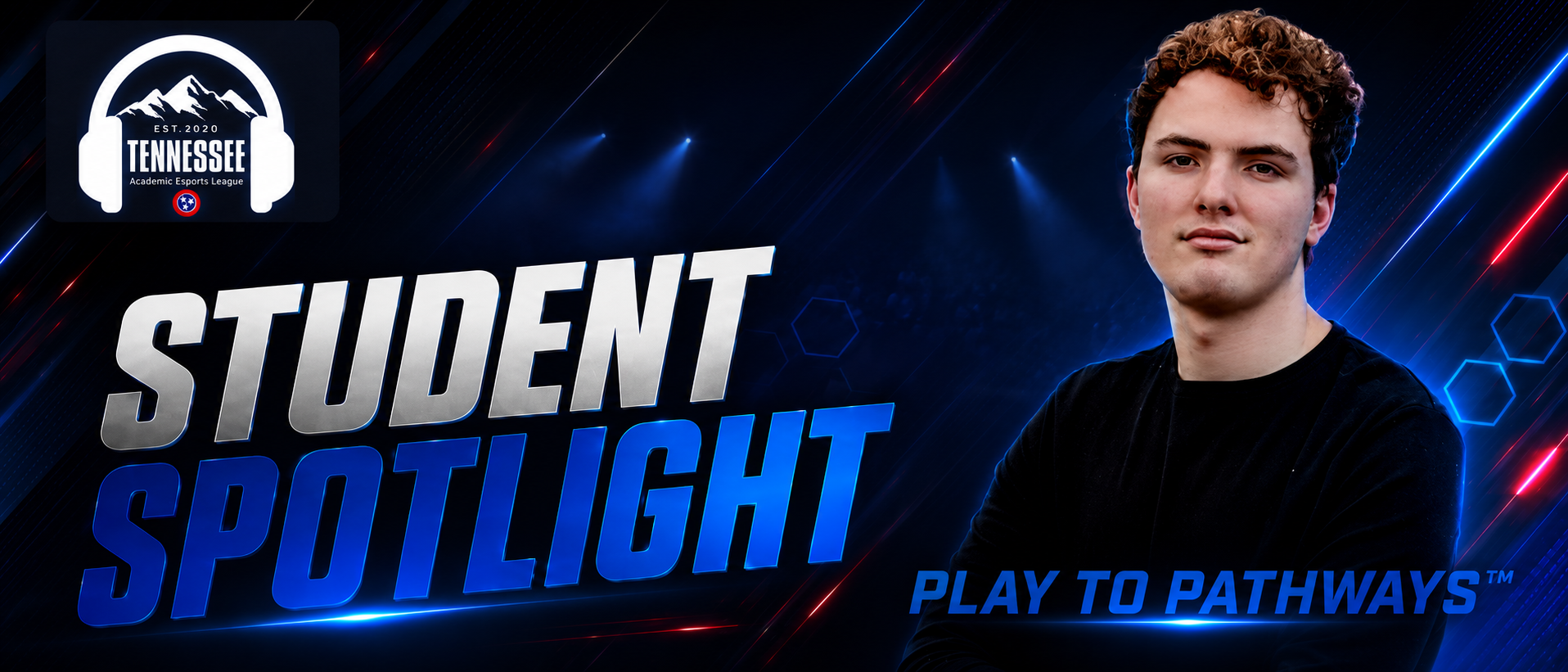
Student Spotlight: Quinn Kelm
Student Spotlight
Quinn Kelm
A state championship, a growth mindset, and a path to Full Sail. This is what scholastic esports actually builds.

- SchoolCurrey Ingram Academy
- TeamCurrey Ingram Mustangs esports, Gold team
- AchievementState champion, Super Smash Bros.
- MainSonic, with Joker as a secondary
- Next stopFull Sail University, Business of Gaming and Esports
When people hear the word esports, a lot of them stop at "kids playing video games." Quinn Kelm has a better answer, and he gave it without being prompted.
"It's about developing a Growth Mindset overall. Practicing new tricks and things to learn."
Then he explained what that means in practice, using a fighting game matchup as the example. If he is playing Ken against Blanka, he has to know when to play defensive and when to play aggressive, because Blanka is a grappler. He has to know his opponent's combos and playstyle to master the matchup, and he has to know his own inputs instantly.
That is scouting, film study, and self-assessment. It is the same work a wrestler does before a meet. Quinn just happens to do it with a controller.
The championship
Quinn is a recent graduate of Currey Ingram Academy, where he finished his senior season with the Currey Ingram Mustangs esports Gold team. This spring, the team captured the state championship in Super Smash Bros.
He remembers the final as the hardest match his team had ever played.
"It definitely meant a lot of things to me, from improving overall, changing my mindset mid-game, having the best match of the season and winning it."
Read that list again, because the order matters. Winning is fourth. The first three are about getting better, adjusting under pressure, and performing at his personal peak. That is an athlete's answer.
Why Sonic
Ask any competitor about their main and you learn something about how they think.
"I play Sonic because I'm a huge Sonic fan in general. Two, his playstyle is known for perfect agility, great mixups, edgeguarding and most of all his spindash. He fits me best because of his reaction time and his fast gameplay."
He used to main Sora, but moved on because he is a floaty combo-chain character whose movement is slow and does not fit Quinn's play style. He thinks Sora is a strong pick for someone who plays a trapping, air-control style, the way a Jigglypuff or Kirby player does. It just was not him.
Knowing which tools fit you, and being honest when they do not, is a skill that transfers well beyond a fighting game.
What the team gave him
The part of Quinn's season that will not show up in a bracket is what he did for his teammates.
"It helped me coach some of my peers when trying to find a character to main, or helping with a certain matchup."
A senior spending his practice time helping younger players find their footing is exactly what a captain does. He also credits the team with connecting him more closely to his coaches and to students he would not otherwise have met.
What he would build
We asked Quinn to design his ideal esports program, and his first answer was not about hardware.
He wanted a mentor on staff for students who are struggling. Someone who could pull a frustrated or upset player aside, take them somewhere quiet, and help them work through it before sending them back.
His second answer was a coach who has actually competed at a high level. His third was equipment, and even there he was specific: skip the televisions unless they have a proper game mode and good frame rates. He highlighted using gaming monitors instead of televisions, and running them through a capture card so matches can be streamed. He also recommends gaming chairs where students can sit comfortably for hours.
A student whose first instinct for program design is student mental health, and whose second is qualified coaching, has understood something a lot of adults miss.
One thing he would change
Quinn had a clear answer about what scholastic esports is still missing.
He wants in-person matches, the way schools already do soccer and every other sport. Playing from separate buildings is fine, but it is not the same as being in a room together with something on the line.
Quinn is right, and he is not the only student who has told us this. It is exactly why events like CyberCon matter. The CyberCon Invitational Tennessee High School Esports Championship brings students from across the state together to compete in person, meet college and industry representatives, and see how esports connects to real career pathways. TAEL is a proud partner of CyberCon, alongside the educators, schools, and organizations who bring it to students.
We want more of that, not less, and it is students like Quinn who keep pushing us to get there.
What is next
Quinn is heading to Full Sail University to study Business of Gaming and Esports, with the goal of competing on the university's esports team.
Full Sail's collegiate program is Full Sail Armada, launched in 2018. Its varsity division fields a Super Smash Bros. team, and varsity players receive team jerseys, funding for tournaments, a dedicated coach, and priority for match streaming.
Armada competes out of the Full Sail University Orlando Health Fortress, an 11,200 square foot arena that the university describes as the largest collegiate esports venue in the country.
His model is Juan "HungryBox" DeBiedma, and not only for the trophies. Quinn talks about what HungryBox has built around the game: becoming a co-owner of Team Liquid, running a community tournament series shaped by viewer votes, and now partnering on a local series in Orlando.
"He has done so much for the esports community and Smash. So I want to be a person like him, from being a competitor, streamer, and someone who supports the esports community in many ways."
That is a career plan. A real one, in a real industry, and it started with a high school team.
His advice
We asked Quinn what he would tell a student who is curious about joining an esports team but is not sure they belong. He answered with a line from Kingdom Hearts.
"Let your heart be your guiding key."
If you have the desire to compete, he says, and you want to be part of a team, whether that is a fighting game, a shooter, or a strategy title, then you already know.
Coaches: every school in Tennessee can field a team. Season pricing starts at $100, there is a no-cost option for schools without funds, and no school is ever turned away. Register at tnacademicesports.com/register or email info@tnacademicesports.com.
Students: ask your school if they have a team. If they do not, ask what it would take to start one. Quinn did not wait to be invited either.
Student Spotlight is a Tennessee Academic Esports League series highlighting the students behind the scoreboard. Know a student we should feature? Email info@tnacademicesports.com.
About the Tennessee Academic Esports League
The Tennessee Academic Esports League (TAEL) is the official governing body for K-12 scholastic and academic esports in Tennessee. A statewide 501(c)(3) nonprofit founded in 2020, TAEL works to make competitive gaming accessible to every school in the state, connecting students to belonging, teamwork, leadership, and future-ready career pathways. Learn more at tnacademicesports.com.